Serving, Learning and Rethinking Food Access in Belize
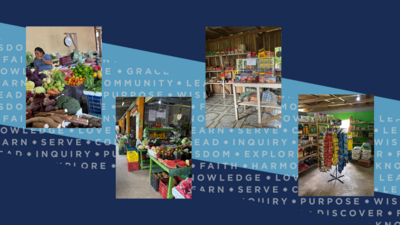
One thing I’ve learned while working in southern Belize during my sabbatical is that public health advice only works when people actually have the ability to follow it. In textbooks and classrooms, nutrition guidance sounds straightforward. Eat more fruits and vegetables. Reduce salt. Choose whole foods. Limit refined carbohydrates. These recommendations show up in nearly every guideline for preventing and managing conditions like cardiovascular disease, diabetes and high blood pressure. But advice assumes access, and access isn’t equal everywhere.
In some of the remote villages where I work, small corner stores are the primary place to buy food. Their shelves are often stocked with packaged snacks, sugary drinks and a few basic staples. Fresh fruits and vegetables are limited or sometimes missing altogether. Even when fresh foods do show up, they’re often more expensive than the packaged options and have a short shelf life.
One day I was working alongside the community health worker during a clinic day in one of the villages. A doctor had just seen an elderly woman whose blood pressure and glucose levels were extremely high. In the U.S., someone with numbers like hers would likely be sent straight to the emergency room. I honestly wasn’t sure how she was even upright.
After the appointment, the doctor asked if I could talk with her for a few minutes about nutrition. So, I asked her a simple question. “What do you usually eat in a day?” Her response, “Mostly a corn tortilla with salt.” That wasn’t just one meal; that was most meals. It wasn’t a preference but simply what she had. Moments like that make you think differently about nutrition counseling. It’s hard to recommend fresh produce when someone’s daily meals are shaped by what is nearby, what stores can carry without refrigeration and what a family can realistically afford.
What makes the contrast even more striking is that just down the road in Punta Gorda there is a beautiful open-air market. It’s one of the most colorful and lively places in town. Tables are piled high with bananas, papayas, pineapples, tomatoes, peppers and more. Strolling through the market has become one of my favorite daily routines. Locals sell fruits and vegetables,vendors offer tamales and fry jacks, and the air carries the smell of spices and fresh food cooking. I often stop to buy homemade tortillas from a local woman who makes them fresh each morning along with fruits and vegetables my family will need for the day.
The abundance is striking. Yet for many people living in surrounding villages, getting to the market regularly isn’t easy. The distance, the transportation and the time it takes to travel into town can make a simple market trip difficult. So, the food exists, but access is uneven.
Agriculture is a major part of Belize’s economy, and farmers grow a wide mix of crops including corn, beans, rice, bananas, citrus fruit, mango, watermelon and more. Some households maintain backyard gardens with fruit trees, herbs, peppers or tomatoes. However, many families in remote villages still rely heavily on whatever the local shop carries.
Living here has also made me realize how much work goes into preparing food when convenience options disappear. Back home, I rarely think twice about ingredients or preparation time. Here, cooking often means starting from scratch. Even something simple means chopping vegetables, cooking beans and preparing everything by hand. That experience has made me more aware of the systems that quietly support how we eat. In public health we talk a lot about food choices, but experiences like this remind me that food access comes first.
Living in Belize has also made me think differently about the United States. We tend to assume food access, but many communities face similar challenges such as rural towns without grocery stores, neighborhoods where convenience stores and fast-food restaurants outnumber supermarkets, families stretching food budgets at the end of the month and people who simply don’t have reliable transportation to reach a full grocery store. We even have a name for it: food deserts.
The environments may look different, but the underlying issue is the same. Health advice collides with logistics, cost and availability. The woman eating tortillas with salt doesn’t need another lecture about healthy eating. She needs access to food. Sometimes improving health doesn’t start with new medications or new guidelines. It starts with making sure people can reach the foods that keep them well.
Experiences like this remind us that health isn’t shaped by knowledge alone, but by the environments people live in every day. When access to nutritious food is limited by geography, costor infrastructure, even the best advice can fall short. At Concordia University, Nebraska, our Master of Public Health program prepares students to think beyond individual behavior and address the systems, policies and access barriers that shape real-world health outcomes, so they can make a meaningful difference in communities both locally and globally.

About the Author
Dr. Jen Janousek has served at Concordia University, Nebraska since 2001, where she is a professor in the Health and Human Performance Department and currently directs the Master of Public Health program.
Meet JenniferInterested in Concordia University, Nebraska's Master of Public Health program?