Concordia University, Nebraska Inauguration of Dr. Bernard Bull
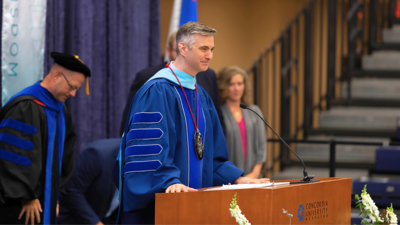
Students, staff, faculty, alumni, regents, Concordia Foundation Board of Directors, and valued guests. It is an honor to stand before you today.
“…it is a serious and important matter that we help and assist our youth, and one in which Christ and all the world are mightily concerned. By helping them we shall be helping ourselves and all men… If it is necessary, dear sirs, to expend annually such great sums for firearms, roads, bridges, dams and countless similar items, in order that a city may enjoy temporal peace and prosperity, why should not at least as much be devoted to the poor, needy youth, so that we might engage one or two competent men to teach school?”
These are the words a 16th century theologian and educator, Dr. Martin Luther, in “A Letter To the Councilmen of all Cities in Germany That They Establish and Maintain Christian Schools.”
Martin Luther went on to summarize three important points in this letter. First, we must make the same level of investment and commitment to the mission of Christian education as we do to topics like infrastructure in society. Second, the goal of ensuring that each person receives an education is inadequate. The type of education matters. It is not just about learned or well-trained people. While the directness of Luther’s words might shock some of our Midwestern sensibilities, they certainly capture our attention.
He wrote, “Indeed, what did men learn in those institutions but how to become donkeys, blockheads and dunces!”
In another place Luther stated, “I am afraid that the schools will prove the very gates of hell, unless they diligently labor in explaining the Holy Scriptures and engraving them in the heart of the youth.”
He warned that God Word is a passing rainstorm. He recounted instances of persistent rejection of God’s Word in a community only to find themselves suffering from the vacuum created by its absence years later. The salt lost its flavor, and the community became bland.
Lutheran education is distinct when and only if it heeds the wisdom of these words and strives for a learning community where we explore a myriad of subjects while placing a high priority on what is taught in 2 Timothy 3. “All Scripture is God breathed and useful for teaching, rebuking, correcting, and training in righteousness so that the man of God may be thoroughly equipped for every good work.”
Luther provided the final summarizing point of his emergent philosophy of education by referencing Psalm 78:5, “He established a testimony in Jacob and appointed a law in Israel, which he commanded our fathers to teach to their children.” Parents teaching their children. Luther’s philosophy of education was grounded in a conviction that our responsibility is not only to learn but to pass on what we learn to others and the next generation. While the world around us is in flux, there are truths that are good and important for all people, all places, and all times. These truths are precious and priceless, blessing many, adding much-needed flavor. As such, our education institutions must be places that embrace new creations and discoveries all while remaining anchored in the unchanging promises of God and the truths revealed in His Word.
Lutheran education, when done well, is salt to the world around it, serving to preserve and flavor families and societies with that which is true, good, beautiful, sometimes even unifying.
Lutheran education, in its elementary, secondary, and higher education expressions, serves to equip people for faith and life in an ever-changing world.
Yet, there is another important role. Lutheran education, when done well, is salt to the world around it, serving to preserve and flavor families and societies with that which is true, good, beautiful, sometimes even unifying.
Lutheran education serves to bless and equip those who participate in it. It blesses those in society through the gifts and abilities of students, faculty, staff, and alumni.
Lutheran education also serves to graduate people who go on to strive for and preserve rights that are critical to the free expression of our faith, rights like the freedom of religion, something under attack in various parts of the world, and arguably under distress in our own society. After all, the story of the Lutheran Church - Missouri Synod, includes an important chapter about a people fighting for the freedom of religion. In the late 1830s, a group of confessional Lutherans left Germany to the United States, with at least one clear and compelling motive being the search for a place where they were free to worship and educate according to their confession.
Less than two months ago, during my installation, I requested that the primary text be Daniel chapter 3, the account of Shadrack, Meshack, and Abednego. These men found themselves living in a nation that was sometimes hostile to their fundamental beliefs. Yet, they sought to love their Babylonian neighbors while working in the King’s court. All was well until the King of Babylon called for all people to bow to an idol of gold made in the king’s own image. These men of God responded with gentleness and respect while resisting, remaining firmly committed to the first commandment, “You shall have no other gods before me.”
Most of you know how the story ended, a powerful message of three faithful servants of God, but even more importantly a message of God’s faithfulness to them and to us. We have a God who will step into the fire with us, a God who hung on a cross for us, rising on the third day, a God who, in Jesus Christ, defeated sin, death and the devil.
What I also see in this account of Daniel 3 are men with chests, in contrast to what C.S. Lewis described as “men without chests.” We are part of a society that too often mocks and rejects virtues only to find ourselves later grieving their absence. A Lutheran education is one that is devoted to deep thinking, intellectual and moral virtue, the cultivation of excellence and new skills to be used out of love for one’s many neighbors, and an intentional faith formation grounded in God’s Word and informed by the great doctrines of our church. The result is a people who can be salt and light regardless of whether they live among those who are friend, foe, or indifferent to the church’s confession.
It is an incredible honor to be serving the community at Concordia University, Nebraska, and one that I admittedly embrace with no small measure of fear and trembling. Fortunately, we have a God who can do much with little, even creating the world out of nothing. And, so, here is my commitment to this community. During the time that God sees fit for me to serve at Concordia, following is what you can expect from me. I share this while also asking for your partnership in keeping these promises, just as we promise an education characterized by, but not limited to community, inquiry, purpose, and wisdom.
First, it is my prayer that we be a community where all roads lead to the nave, where we regularly gather at the foot of the cross, learning from God’s word, receiving God’s good gifts in the Lord’s Supper, joining in prayer and the singing of psalms, hymns, and spiritual songs. I’ve already promised our campus pastor, Pastor Matthias, that it is my intent to create a serious problem for him, namely that we run out of room in daily chapel. For all of you mission-minded trouble-makers, please join me in creating this problem for Concordia.
Second, now is the time for us to dig deep into our Lutheran education tradition of what I refer to as mission-minded innovation.
Some of our Reformation predecessors championed education for both boys and girls at a time in history when some might have deemed it a radical concept.
And this legacy of innovation traveled across the ocean, evident in the launch of hundreds of US elementary schools, secondary schools, and higher education communities, including one launched in this very town in November of 1894, the Evangelical Lutheran School Teachers Seminary, later known as Concordia Teachers College, and today as Concordia University, Nebraska. Concordia and many other such Lutheran schools were not simple replications of past endeavors. They were and are expressions of mission-minded innovation, ultimately in service to the Gospel of Jesus Christ.
This history of Lutheran education is a rich and inspiring story of creativity and creation in service to a far more critical mission, the ongoing faith formation of people of all ages.
It can be said that a mission is a wild and untamed thing that will call for us to step out and beyond what is familiar or comfortable, if only we heed its call; embrace a spirit of humility to look, listen, and learn from what is happening around us; and have the courage to embrace new possibilities and opportunities. Even as we strive to sustain the best of Concordia, we are part of a tradition that also embraces the opportunity to respond, adapt, and create.
Third, I challenge us as a community to embrace our educational mission in a way that both equips students to be salt and light in the world, while simultaneously seeking to be a university and community that is itself salt and light. This means focusing upon nurturing those within our community even as we seek ways to share and reach out to others beyond the Concordia campus. This may take the form of faculty scholarship; art, music, and other creative works; being a forum and hub for exploring and addressing critical issues in society; engaging in acts of service; embracing shared efforts to launch and expand Lutheran schools and new forms of ministry.
We do this heeding the wisdom of Matthew 5:14-16, “You are the light of the world. A city set on a hill cannot be hidden..” And later on, “…let your light shine before others, so that they may see your good works and give glory to your Father who is in heaven.”
Fourth and finally, now is the time for us to deepen our resolve and commitment to growing as an intentional Lutheran community, a community of Christian scholarship, lifelong catechesis, and ongoing faith formation.
In 1991, James Burtchaell published “The Decline and Fall of the Christian College” (April 1991. First Things). He outlined nine elements of how a once distinctly Christian university might find itself largely secular over time. While I will not list all nine it is my prayer and resolve that we will do the opposite of what is described in each of those nine items.
We will seek and celebrate a strong and positive relationship with our church body, The Lutheran Church—Missouri Synod, seeing it as a strength and as a blessing to Concordia and to society. We will be the church’s school.
We will embrace the intersection of faith and academic disciplines, seeing the tensions as opportunity to learn and ultimately serve our neighbors.
We will hold the President accountable for championing Christ-centered academic excellence and seeing the “Christ-centered” as an essential ingredient to what we mean by excellence.
We will resist the temptation to pursue funding or dependence upon secular sources that lead us to compromise on our mission, identity, and convictions.
We will continue to celebrate a community of staff and faculty who embrace a first loyalty to the mission of the church, even over (but not in place of) a sense of obligation to one’s academic or “disciplinary guild”.
We will strive to identify and support staff, faculty, and administration who value the perpetual search to understand how their faith informs their work.
We will remain clear and candid about our Lutheran and Christian identity, even as we strive to serve and love many and diverse students and neighbors in our community and beyond.
We will not be isolationist, nor will we assimilate. We will embrace the call to love our many neighbors in the world through our vocations. By God’s grace, we will be salt and light to one another, our community, and society.
For those of you who know Concordia well, you recognize that these statements already describe much of what happens here. At the same time, you also know that we have room to grow, and that these convictions are like plants that require our ongoing care, attention, and intentional tending. I look forward to engaging in that good and important work with so many of you in this room.
These are exciting times to be a Lutheran university. There will troubles, uncertainties, and complexities to navigate. Yet, by the grace of God, we move forward with courage and conviction, knowing that we have a God is with us, and who is capable of immeasurably more than we can imagine.
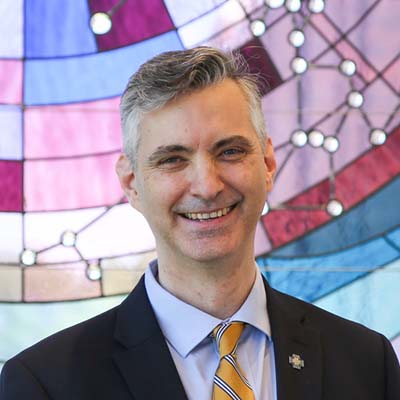
About the Author
Dr. Bernard Bull serves as the 11th President of Concordia University, Nebraska. His work focuses on futures, the philosophy and praxis of Christian education; models of educational research and development; and the intersection of education and digital culture.
Meet Bernard