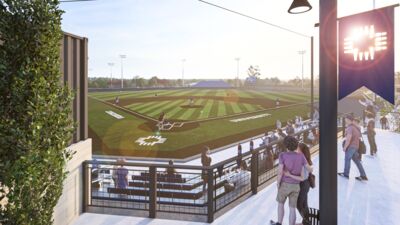
A version of this story first appeared in the summer 2026 edition of Concordia University, Nebraska’s Broadcaster magazine. The following piece provides extended details on the Ballfield Project. To view the entire Broadcaster issue, click HERE.
For more details on Concordia's Shine Forth campaign, and how to supoort it, click HERE. Concordia continues to seek funding for the Ballfield Project.
----------------------------
A ballfield will return to the same plot of land where the legendary Bob Gibson once toed the pitching rubber and where Concordia Athletics Hall of Famers such as Dick Everts, Jim Juergensen, Vic Peter and Gary Seevers forged memories and moments that endure into the present day. Come 2027, the grass practice field situated within the east campus valley will be transformed into a championship level facility complete with synthetic turf.
Included in the Concordia University, Nebraska masterplan is the ultimate vision for an outdoor athletics village that will triumphantly return the baseball and softball programs to campus while adding turfed spaces for multi-sport usage and relocating the throwing venues, bringing them closer to the Walz Fieldhouse and Bulldog Stadium track. Step by step, a project that has been in the making for more than a decade is taking shape. In July, Concordia went public with the initiative as part of its Shine Forth campaign.
Phase one of the project prioritizes the on-campus baseball-softball hybrid field, which will be tucked within the east campus hills. The southeast facing complex has been designed to feature stadium seating with a built-in press box and spacious sunken dugouts along with modern LED lighting and a large right-center field scoreboard. The fence in right field will border along the tennis courts. The field will also be fitted with an adjustable mound and basepaths, as well as portable fencing, allowing for softball and youth baseball to be played on the diamond. The grandstand will fit roughly 300 fans with additional seating extending to the surrounding grass berms.
Concordia University, Nebraska President Dr. Bernard Bull stated, “We have a nationally relevant athletic program at Concordia, and that is certainly evident in our baseball and softball teams. This is our chance to create a high-quality competitive surface that matches the level of excellence that we see in these teams. Yet, there is another part of this project that is truly exciting for me, because as much as we value excellence and wins in athletics, we are even more committed to using athletics as a means of nurturing young men and women of Christian conviction and character who go on to be a great blessing in their families, churches, communities, workplaces and around the world.”
The completion of the project will be the result of hundreds of meetings and conversations that have taken place behind the scenes over the past decade. The process picked up steam in 2019 with the support of former university president Brian Friedrich and has continued to gain traction under the leadership of President Bull. In the quiet phase of the Shine Forth campaign, Vice President of Institutional Advancement Derek Engelbart and his team have secured funding to set the multi-million dollar project into motion. The fundraising initiative is ongoing with phase one just getting underway. The ballfield will be completely funded by philanthropic dollars.
The project has become a priority for many reasons. For more than 30 years, Seward’s Plum Creek Park (natural grass fields), located on the northeast part of town, has served as the home field for the Bulldog baseball and softball programs. Particularly for baseball, the constraints of operating on a single shared field have intensified. During the 2026 season, Coach Ryan Dupic’s squad played only four games at Plum Creek Park due to the combination of inclement weather and field availability. Weather challenges have impacted Concordia baseball for decades, resulting in constant rescheduling, logistical headaches and missed classes for student-athletes. No longer will the Bulldogs have to move home games to Lincoln or to the opposition’s home venue.
Additionally, there’s long been an appetite for the baseball and softball programs to feel included within the campus community. Students will soon enjoy the opportunity to catch a ballgame mere steps from their dorm rooms and academic buildings. The on-campus fields will bring all parties involved – athletes, coaches, staff, fans and community members – into closer proximity.
Says Engelbart of the benefits, “It supports and builds community. This is literally over by Phillip, Timothy and David dorms and just up the walkway from the Janzow Campus Center. It’s going to build a natural space for community and for people to hang out. This is going to be a real blessing to the entire campus community, Seward County and surrounding areas.”
Former President Friedrich made a declaration announcing the plan for the outdoor facilities project at the 2019 Bulldog Golf Classic. In the years since then, Dave Kumm, who retired his position as Chief Operating Officer in January 2026, has overseen the master plan as Project Manager. The endeavor has required the collaboration of Kumm and the advancement office, along with athletic administrators Devin Smith and Angela Muller, as well as coaches Ryan Dupic and Brock Culler and outside entities such as Nemaha Sports Construction and JEO Consulting Group. Many others have also provided input and support.
Throughout 23 years of service to Concordia, Kumm presided over the planning and building of numerous on-campus facilities, including the recently constructed Dunklau Center for Science, Math and Business and Borland Center for Music and Theatre. Nearly two decades ago, Kumm helped bring about the Walz Human Performance Complex. Now in his retirement, Kumm is determined to see out one final project. He’s the guy that makes things happen. As Kumm detailed, the plan for the hybrid baseball-softball complex has been altered over time, and multiple options were considered, including potential upgrades to Plum Creek Park. At one time, the master plan even contained a chicken coop.
“The contractor is really excited about this project,” Kumm said. “I’m really excited about it. I think where we’re placing it – any student that comes on campus with the thought of baseball or softball – they’re going to look down at where they could be playing and will be in total awe. It’s one of those fields that’s out there that you’d never expect. They’re going to be so shocked when they see it because it’s going to be first class all the way around. I think it’s important for Concordia. In everything we’ve built, we’ve done it first class. This is going to be the same.”
Of course, the on-campus stadium will bring a flood of nostalgia to alums who played ball on the Concordia dirt, Sandlot-style, in the 50s, 60s, 70s and 80s. The words of Terrence Mann in Field of Dreams may even ring true: “They'll watch the game, and it'll be as if they'd dipped themselves in magic waters. The memories will be so thick, they'll have to brush them away from their faces.”
On a Friday in early June, Engelbart and Senior Director of Development and Engagement Scott Seevers led a discussion on the project with a group of baseball alumni. Vic Peter proudly presented a news clipping detailing Concordia’s 14-3 win over Bob Gibson and his Creighton team in 1956. Some attendees were surprised to learn that Gibson “threw aspirin” (as Peter put it) right there on the Concordia campus. Meanwhile, John K. Seevers reminisced about the intimate atmosphere at the old ballfield next to the tennis courts, where students watched games from the hill and blared music out their nearby dorm rooms. A former student-athlete and coach, Tim Warneke inspired laughs in describing the unique ways the baseball program raised money after it was nearly cut following the 1987 season.
As Director of Athletics, Devin Smith highly anticipates the day when he can introduce the facility to the department’s coaches, student-athletes and staff. Smith advises that the complex will alleviate travel and load weight for athletes, coaches, athletic trainers and other support staff, yielding a higher quality of life and more personal time. At last, the baseball program will have opportunities to practice as an entire team on campus with minimal field maintenance required. Both baseball and softball will likely play home games more often and earlier in the season, and the presence of synthetic turf serves to lessen the impact of Nebraska’s bipolar spring weather.
Then there’s the ‘wow’ factor. Says Smith, “It’s a gamechanger. It demonstrates clear value in return for all the hard work and success that students and alums have went through with this program. It provides premiere venues for our campus and our students. This project has been part of the journey for this campus since the stadium and track were built in the mid- to late-90s (dedicated in 1997). Then in 2010, we added the Walz Complex. Every facility raises the level of impact that Concordia University, Nebraska has within our state and our region.
“We have an opportunity to become the premier campus in terms of having an athletics village where you walk out the south doors of Walz, and within 150 steps any direction, you can be at a competition venue. It sets us apart.”
The visual renderings produced by JEO Consulting Group provided a strong selling point for Engelbart and the advancement office as they began pitching the project to potential donors. Both Kumm and Engelbart have received encouraging feedback throughout the process. As Engelbart said, “The response has been overwhelmingly positive. There are so many people that say this is going to be an incredible blessing for so many people at Concordia. For them to follow this vision and see that it’s updated with new technology and the synthetic playing surface, they’re even more excited. There’s a growing demand for field space and Concordia can help be part of that solution while serving students and staff here.”
Over 12 seasons, Dupic has transformed the baseball program despite limited access to a baseball field. The bulk of practice during Dupic’s tenure has taken place in spaces such as the Walz Fieldhouse, the indoor hitting center and Bulldog Stadium when weather allows. All the while, Concordia has won a combined eight GPAC championships and has qualified for eight national tournaments, including a run to the 2021 NAIA World Series. The stature of the program will only be enhanced by the new facility.
Concordia began playing home baseball games at Plum Creek Park in 1992. With a bond recently passed in Seward, the Plum Creek field is due for future upgrades of its own. In other words, the infrastructure for baseball in the city of Seward is about to explode in ways that will benefit all sides. The Bulldogs are dreaming about hosting GPAC and NAIA National Championship postseason games on their own campus. It’s the type of scenario that former longtime head coaches like Frank Greene (softball) and Jeremy Geidel (baseball) envisioned in their own tenures. It’s about to become a reality.
“I first think about the players and the parents and the opportunities we would have to compete on campus and have more consistency with scheduling,” Dupic said. “The schedule is a really big challenge. That’s the nature of having a baseball program in this region. I think a lot of people who recognize our situation respect the success that we’ve had given we really haven’t been able to practice on a baseball field. Having a chance to be able to do that would be a great opportunity for us to provide a much better experience for our student-athletes and allow us to continue to improve competitively.”
Meanwhile, Brock Culler and the softball program believe they are on the cusp of something special. With the high school softball season taking place in the fall, the burden on Culler’s program is not nearly as cumbersome, but there’s a hunger to be part of the action taking place just off Hillcrest Drive. Commented Culler, “It’s going to give our current athletes a better experience. We’re probably going to get more students at our games because they don’t have to drive to Plum Creek. They can walk out of their dorm and come right over. The overall student experience is going to be a lot better. Moving equipment and things like that will be a lot easier to manage. We’ll be able to schedule home games earlier in the year. You want something you can call your own.”
Fresh off an early June discussion with Nemaha Sports Construction, Dave Kumm advised that the project is full steam ahead while the advancement team continues to seek finances that will support the entire scope of the initiative. Kumm cautions that the timing depends upon God, weather and unforeseen factors.
“I’ve been promising Coach Dupic for a long time,” Kumm said. “It’s been a lot of work. I will have a lot of joy and pride when I see this thing completed and see the impact. The most important thing is the impact on the students. That’s what kept me at Concordia for 23 years. This is going to lift everything up in athletics and the campus to a new level.”