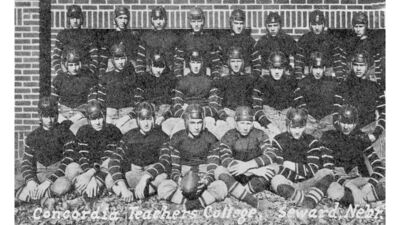
Homecoming week on the Concordia University, Nebraska campus provides an opportunity to look back at the school’s history and traditions. The passage below was taken from the book, Cultivating Men of Faith and Character and details the beginnings of the football program at Concordia. The 2026 season marks the 100th for Bulldog Football. More than 100 years ago, the Concordia edged Doane, 9-6, in the first game counted in official records.
For additional reading on uniquely Concordia traditions, click the links below.
LINKS:
· How Concordia became the Bulldogs
For a complete schedule for homecoming 2026, check out the university’s homecoming webpage here: https://www.cune.edu/alumni/homecoming-weekend. Concordia will officially induct the Hall of Fame Class of 2026 at a ceremony scheduled for 5:30 p.m. CT on Friday, Sept. 18.
------------
On October 16, 1925, Concordia Teachers College placed a varsity football team on the gridiron, pitted against an opposing institution for the first time in history. Under the direction of faculty member Walter Hellwege, one of the most influential figures in the school’s athletics history, the leather-helmet adorned squad from Seward edged Doane College, 9-6, for the first official win in program annals. At that time referred to as the “Teachers,” Concordia (founded in 1894) adopted the Bulldog mascot in the fall of 1934 after a student body vote. The name fit perfectly considering Hellwege’s pet bulldog often accompanied him to games.
Thus, it took more than 30 years after the first classes commenced for football to gain traction at Concordia. In the school’s founding year, President George Weller taught a group of 13 initial students inside the only building that existed on campus, the “Old Dormitory,” what later became known as Founders Hall. Students who attended the inaugural year of classes lived inside the Old Dormitory, as did President Weller and his family. The students paid $48 for board and $2 for fuel and oil. These facts were relayed in a 1934 Broadcaster issue that told “The Story of Concordia.” In it, only slight mention of athletics is made. It stated that “there is positively no written record of sports at Concordia during the early years.” But President Weller supported the notion that engagement in sport could help make a “fine spirited teacher.” Baseball, skating and tennis were some of the early activities taken up by Concordia students. Football followed soon after. President Weller’s sons, John and Bob, were All-American football players themselves at the University of Nebraska in the 1900s.
John and Bob were forced to find more organized football outside of Seward because the sport had been simply an intramural affair at Concordia. Out of these intense intra-class games grew a hunger for a more competitive brand of ball. After Hellwege blazed the trail in 1925, the “college in the cornfield” did not play an intercollegiate varsity football competition in 1926 or 1927, but such contests reemerged in 1928 and Concordia has fielded a team each year since then, with the exception of 1943 as World War II raged on. There have been many ups (337 wins to be exact) – and downs (383 losses and counting) – in the more than 90 years since the program’s birth. There have been numerous great teams and players. Three different Bulldog editions (1931, 1944, 1945) have run through undefeated seasons, 13 have seized conference titles and 17 have posted seven or more triumphs in a season.
Bernard “Arkie” Arkebauer emerged as perhaps the program’s first mega star player for the juggernaut 1931 team. Arkebauer was one of many young men who came to Seward for both high school and college until Concordia High School’s closing in 1972 (the Board for Higher Education of the Missouri Synod recommended the closure of the high school while estimating an annual savings of between $40,000 and $80,000). Well before the era of prolific passing attacks, Arkie punished opponents by scoring 19 touchdowns, a single-season individual record that stands to this day. That ’31 squad was the first team ever inducted into the Concordia Athletic Hall of Fame. So utterly dominant, Arkie and company went 7-0 while outscoring their opponents by a combined total of 206-19.
The Hellwege years gave way to the Herb Meyer coaching era. Meyer oversaw what could accurately be argued as the golden age of Concordia football in terms of wins and losses. Meyer guided the Bulldogs to back-to-back undefeated campaigns in 1944-45. Then from 1949-54, Meyer’s teams went a combined 41-8-4 and captured Central Church College Conference championships in 1951, 1952 and 1954. That type of on-field success has not been duplicated in any other six-year stretch in school history.
In more recent years, Courtney Meyer led Concordia back to prominence in 2001. Then in his 12th year as head coach, Meyer directed his Bulldogs to a Great Plains Athletic Conference crown (still the program’s lone GPAC title) behind All-Americans such as tight end Ross Wurdeman and defensive back Sean Stewart. The 2001 Bulldog squad broke a then 20-year-old school record for wins in a season, recording victory No. 10 via a 31-26 decision over St. Ambrose University (Iowa) in the first round of the NAIA playoffs.
Through all the glory of momentous wins and the agony of heart-breaking defeat, nine different head coaches have led a program that has cultivated men of faith, character and influence for nearly a century. A 2004 Lincoln Journal Star news article quoted Courtney Meyer as saying, “We are a university of a high reputation, centered on Christian values.”
This ideal served as the foundation upon which the likes of Arkie, the Oetting brothers, Cleve Wester and Von Thomas have thrived. It carries on in the present with current head coach Vance Winter.
This historical narrative of Concordia football, organized coach-by-coach, attempts to tackle all of the memorable teams, players and moments since Hellwege’s boys first donned those charming leather helmets.
----------
As stated by the 1920 edition of “The Pioneer,” the earliest annual yearbook in existence in Concordia’s library, football fostered “great interest always shown among the boys.” Football spawned because of this growing demand from students. There is photographic evidence of intra-class games being played between pick-up teams as early as 1913. The sport’s popularity grew on campus to the extent that students petitioned the faculty and board of directors “for the permission to compete with other schools.”
The board granted that request and football began to take off (In 1921 students also voted to remove Concordia from the town of Seward. That request was denied!). While 1925 marks the first recorded varsity contest, Professor Walter Hellwege can be found pictured as coach of the team as long ago as 1921. Hellwege was a busy man. In that same 1921 publication (“The Mirror”), Hellwege also appears as the coach of the baseball and basketball teams.
A 1919 Concordia graduate, Hellwege immediately began his professional career as a member of the faculty at the teachers college. The following passage details Hellwege’s initial involvement in athletics. Despite his lack of an athletic playing career, Hellwege was a popular choice to help lay a foundation for Bulldog football and for athletics at an institution that would not become a four-year college until 1937. (CTC offered a third college year beginning in 1933-34).
“(In 1919) the students asked Professor Hellwege to take over the duties of coaching teams. Since he had never participated in football, baseball or basketball as a student, the request was unexpected and he hesitated. But at the insistence of the students, he consented to try. He enrolled for a nine-hour course in the fundamentals of various sports, with the coaching staff of the University of Nebraska. Armed with this experience, he began to coach teams in basketball and football and helped to organize a junior college conference with three other Lutheran colleges in Nebraska: Dana, Luther and Hebron. Since there were only four teams in the conference, each team faced each of the others twice each season. With this beginning of intercollegiate competition, Hellwege immersed himself in earnest in the study of offense, defense and every type of strategy that might contribute to the building of successful teams.”
It was clear that Hellwege’s actions demanded respect among faculty and students. In turn, Hellwege gave a lot back. A 1931 edition of The Broadcaster provided further insight into the early days of varsity athletics: “Many an hour is devoted to his tasks as director of athletics. It is largely due to his insistence on high ideals of sportsmanship that we not only have had good teams, but that a fine spirit of sportsmanship has been displayed by both teams and rooters in competitive contests.” According to his wife Margaret, Hellwege once said, “My boys would run through fire for me!”
No accounts were found of the very first intercollegiate contest, just a score – a 9-6 victory over the “Doane freshmen.” By 1929, the Teachers claimed their first-ever conference championship, needing only three wins to do so. A review from that season stated, “there is a silver football in the trophy case.” Concordia used triumphs over Luther College twice (34-0 and 27-0) and Dana College once (33-0) on the way to a championship while up against a meager schedule in relation to today’s standards.
Respectable records of 3-2 in 1929 and 3-2-1 in 1930 led into the historic 1931 campaign. Several game accounts courtesy of the “Concordia College News” provide details of the dominance displayed by the team powered by captain Herbert “Bulldog” Meyer and Bernard “Arkie” Arkebauer (both members of the Concordia Hall of Fame). Thirty-five team members made their way to the practice fields that year as the temperature climbed above 100 degrees for the opening of the fall term. Twenty of those squad members earned letters the previous year. According to The Broadcaster, “a number of these were out teaching during the past year and have returned with increased weight and confidence.” The same preseason outlook hyped the looming rivalry games with Dana, which “gave us a trimming last year.”
On his way to scoring a program record 19 total touchdowns (still a single-season school record), Arkie pretty much did it all. He ran for touchdowns, he caught touchdowns, he punted and he made opposing quarterbacks pay for mistakes by plucking interceptions. Wrote the Concordia College News, “Of course, we all know that there is Arkebauer as do all of our opponents. The husky Kansan just seems to have a way of making his presence felt.” With Arkie at the forefront, it would be Concordia doing the “trimming” in 1931.
In facing its stiffest competition all year, Arkebauer showed off his big-play ability by returning an interception 70 yards for a score – only to have it called back by an offside penalty. In that same game – a 21-7 win over Hebron Junior College on November 7, the “husky Kansan” made a spectacular catch of a pass from Meyer and “went for a touchdown being tackled just as he crossed the line.” With the victory over Hebron, CTC pushed its mark to 6-0 and locked up a Nebraska Junior College Conference championship.
Indeed, Arkebauer and Meyer made for a deadly combo. They powered the 1931 team to a 7-0 record while outscoring opponents 206-19. They won games by counts of 25-0 over Nebraska Central, 31-0 and 32-0 over Dana, 13-12 and 21-7 over Hebron and 54-0 and 31-0 over Luther. In the 54-0 “snowing under” of Luther, Meyer tallied three scores and Arkebauer two. Even at a time when the forward pass had yet to become vogue, this team had aeronautical flair. Meyer raced into the end zone on a 20-yard “reverse lateral pass” for the fifth touchdown of the trouncing.
To this day the 1931 squad stands as arguably the best in program history. It held opponents to an average of a mere 2.7 points per game – a program record that is unlikely to ever be broken. The departing lettermen on the ’31 team included The Bulldog Meyer in addition to guard Cocky Hellbusch, center Gib Kufahl, tackle Pop Stohlmann, end Fritz Kauffeld, end Ray Maag, halfback Emilia Petsch, guard Vern Ronnekamp, guard J.B. Tucker and tackle Bill Zobel. In summary, The Broadcaster read: “This year’s team and the record they set will remain long in the memories of sport fans who give their loyalty and support to the school and its activities.” The glorious season provided a measure of relief as America suffered through the Great Depression. As stated by The Broadcaster, “The financial depression which is holding our country in its grasp could hardly be expected to leave our institution untouched.”
Arkie had already become well known in Seward during his time at Concordia High School. A 1930 headline read, “Arkebauer stars as high school trims Geneva, 19-6.” In that contest Arkie scored all three Concordia High touchdowns, one of which came on an 80-yard punt return. In continuing his flair for the big play, Arkie intercepted a pass and sprinted 70 yards for the game’s final score. In the November 1930 edition of The Broadcaster, Arkie was credited with punting a ball 70 yards and scoring the only touchdown of a 7-0 win in the rivalry game with Seward High School. He never stopped scoring touchdowns. Before engineering CTC’s perfect 7-0 season in ’31, Arkie paved the way for Concordia High School’s 6-0 campaign in 1930. Not only that, Arkebauer played center and captained the CTC basketball team that won the 1931 Nebraska Junior College Conference championship.
Very few individual athletes were featured in The Broadcaster during the 1930s, but an exception was made for the incredible Arkie. The publication revealed the following account of the then high school senior: “There goes a man through the line. Too bad, two men are on him at the six yard line. But there are the raised arms of the referee. The man scored. That was Arkebauer! Bernard Arkebauer, fullback, from Haven, Kansas, big, with black, kinky hair, is the boy who has been doing things like that all season. We can quite confidently say without delving into past records of Concordia gridiron heroes, that Arkebauer has set up a record that will be good for quite a number of seasons. He scored thirteen touchdowns and five extra points in six games. These touchdowns have been made in almost any method possible. Long runs, crashing plunges, snaring passes are all in his point-producing repertoire. Then on the defense he comes through with such tackles, and long, high punts. And he is not one of these stars who plays well one game then has an off day. He has played superior football in every game and finished with a flashing game at Bethany. True, he had a good, fighting line to help him, but when a lugger is tackled on the six-yard line and then goes over for a touchdown, that’s not a line, that’s Arkebauer!” Not only referred to as Arkie, The Broadcaster once even dubbed him the “Haven Havoc” in a play off his hometown. Unfortunately, Arkie’s compelling story survived in written accounts only, but his greatness was recognized by all who had the pleasure of watching him. In 1949 a group of 45 alums voted on an all-time Concordia football team. Arkebauer topped all vote getters.
The early Hellwege years were simply about just getting the program off the ground. The 1925 squad, Concordia’s first to face an opposing institution, returned only three letterwinners from the 1924 intra-class team. Hellwege’s roster of 35 in that ’25 season also went up against the Lincoln Reserves (14-0 loss) and Seward High School (no result found).
One of Hellwege’s early captains was center Henry Obermueller, who the 1925 school yearbook described as a player with a “habit of tackling opposing backs while the play was young.” He played along with fullback Henry Stroebel, who had been given nicknames, “slippery” and the “fighting Texan.” He was said to be a “dependable line plunger at all times.” One of the first four-year lettermen in program history, lineman Arthur Bangert’s career (1938-41 football seasons) spanned the final three years of Hellwege’s run as head coach and the beginning of Herb Meyer’s tenure. Bangert actually began his college football playing days while still a senior at Concordia High School. In a 1938 loss to Hastings, Bangert was credited with playing “stellar” defense. In the opening game of that season, his blocked punt resulted in a safety that proved crucial in an 8-6 win over Nebraska Central. Bangert, who suffered injury in 1940, also participated as a member of the track team. After finishing at Concordia, he rejected an offer from the Philadelphia Eagles to pursue a career in teaching.
Guys like Obermueller and Stroebel were key players as part of a solid run before Hellwege coached his final game in 1940. He compiled a record of 40-32-9 and put together another successful team in 1936 when the Bulldogs (newly-minted nickname in 1934) went 5-1-2 overall.
At the time of this writing, Herbert Kaiser was believed to be perhaps the lone living person to have played at Concordia for Hellwege. In a letter in which he recalled his memories of playing for the man he knew as “Volley,” Kaiser referred to Hellwege as a good friend. Wrote Kaiser, “I thank God that Volley was in my life. He helped me become the person I am today.” While at Concordia, Kaiser roomed with quarterback Paul Ebel, a nephew of Hellwege. Ebel and Kaiser were often invited over to dinner at the Hellwege’s to eat meals prepared by Aunt Margaret.
More than 75 years later, Kaiser reminisced about a 1934 loss to York. Kicker William Rathe’s shoes were so worn out that he had to borrow a smaller pair from a teammate. As the story goes, Rathe’s tight-fitting shoes caused him to miss a potential game-winning field goal.
That may have been a bitter pill to swallow, but Kaiser’s reflections are overwhelmingly positive. Kaiser called Volley a good disciplinarian who taught spelling and proper grammar, something that those “coming from the cornfields of Nebraska and the wheat fields of Kansas” needed. In turn, the players respected Volley as a good coach and teacher. Hellwege possessed a “booming voice” perfect for a head football coach. He even made use of it to correct students who misused past participles.
Of course, Rathe, a 1996 Concordia Athletic Hall of Fame inductee, was not the only one who dealt with shortcomings in regards to equipment. Volley handed out the best equipment to the players he believed would end up seeing the most playing time. As a freshman, Kaiser received the scraps – a helmet with very little padding and no chin strap. At the time, no players had facemasks on their helmets and some were not even afforded shoulder pads. Kaiser and others suffered broken noses because of the equipment deficiencies. The problem was heightened when Concordia went up against a ‘B’ team from the University of Nebraska and essentially got its teeth knocked in. But Kaiser never complained, writing, “Remember, times were hard and Hellwege kept the athletic program alive.”
Hellwege remained part of the Concordia faculty long after he hung up his post as head football coach. He still kept an interest in sports and sometimes watched football practices. On one of the first-ever TVs on campus, located in Founders Hall, Hellwege marveled at a football broadcast. “It was like a symphony,” Hellwege remarked at the time. In summing up Hellwege’s coaching tenure, one account read, “Everyone who saw Hellwege’s boys in action agreed that he was an excellent coach, who had developed some of the strongest teams that Concordia has ever put onto the field.”
----------
There have been only 10 head coaches in school history. After Hellwege’s tenure as football coach concluded in 1940, Herb Meyer took on the head coaching role from 1941 through 1954. The program continued under the direction of Kennth Schroeder (1955-58), Ralph Starenko (1959-63), Ron Harms (1964-69), John Seevers (1970-76), Larry Oetting (1977-89), Courtney Meyer (1990-2008), Vance Winter (2009-16) and Patrick Daberkow (2017-present). The program celebrated conference championships in 1929, 1931, 1944, 1945, 1951, 1952, 1954, 1955, 1960, 1970, 1981 and 2001.