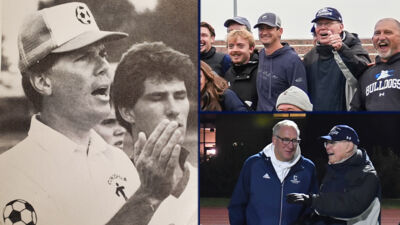
In the middle of festive postgame celebrations stood Dr. Jack Kinworthy. He wouldn’t miss the chance to revel in the glory of a GPAC tournament championship victory inside Bulldog Stadium or a momentous PK shootout triumph over previously unbeaten Eastern Oregon in Olathe, Kansas. It was the fall of 2025 and Kinworthy hadn’t coached a game in more than 30 years. It didn’t matter. “It gets in your blood, you know,” Kinworthy explained.
No one has been closer to the Concordia University, Nebraska Men’s Soccer program for longer than Kinworthy, who never imagined he would spend roughly two decades as the Bulldogs’ head coach. The opportunity fell into his lap in 1974, and he was hooked. So much so that he remains a fixture on game days and within the athletic offices.
With a twinkle in his eye, a common marker of his disposition, Kinworthy can honestly describe his career as the thrill of a lifetime. He arrived at Concordia (along with his wife Judy) in 1969 and served as a Professor of Geology until his retirement in 2007. As he put it, his teaching career was the cake and his coaching tenure was the icing.
“I look back and I thank God for it,” Kinworthy says. “It really was an honor for me to coach and to work with young men. I think they all enjoyed it – and I only cut one guy in 20 years. They were in it for the love of the game.”
A love for the game and for the athletes he coached kept Kinworthy on the sidelines for 232 games over 19 total seasons. Upon having his career record read back to him – 113 wins, 110 losses and 9 ties – Kinworthy remarked, “I’ll take it, given my background in soccer.” Kinworthy managed a winning record while teaching a full courseload and after immersing himself in a crash course on the beautiful game. The St. Louis native never had the chance to play soccer, but he wished he had.
Naturally, the odds were against the Concordia River Forest graduate one day laying the foundation for a program that would later become one of the conference’s best and most consistent in the era of the Great Plains Athletic Conference. But before Kinworthy took the reins in ’74, the program was guided by three different coaches for one season apiece: Manfred Kwiran (1971), Carl Everts (1972) and Terry Boren (1973).
The sport began as a club before being added to the athletic department as an official varsity sport beginning with the 1972 season. A summary following the ’73 campaign turned in by Coach Terry Boren stated that, “The world’s most popular sport is fast becoming one of the most popular sports at CTC … Concordia’s soccer future looks extremely bright, as next year’s team will return 8 starters and 16 lettermen.”
Unbeknownst to Kinworthy, Dr. Carl Everts (Concordia’s Athletic Director from 1973-80 and from 1986-94) had seemingly been grooming the young professor to take over the fledgling soccer program. In the summer of 1972, Everts convinced Kinworthy to accompany him to a 10-day soccer academy along the Hudson River in New York. Kinworthy recalls studying FIFA rules at night, taking a final exam late in the week and coaching young men after applying what they learned from international coaches. On one particular day, Kinworthy was tasked with coaching diving headers – and demonstrating them. The result of the camp was a sore body and an enhanced knowledge of the sport. Both Everts and Kinworthy passed the exam.
Kinworthy served as an assistant under Everts in ’72 and then under Boren in ‘73. At the conclusion of the 1973 season, Everts called Kinworthy in for a meeting. As Everts told Kinworthy, “You know enough about it. You just take over soccer.” Kinworthy laughs thinking back on that exchange. “I went home and told Judy that I’m the soccer coach for this coming season. (Assistant) Joel (Wehrspann) and I went to that camp a second time. It was like a blur.”
The circumstances then were much different than the present. The budgets were minimal and the coaches were stretched thin as husbands/fathers and professionals who made a living in other jobs (such as teaching). There was little time for recruiting, which sometimes happened through word of mouth, Lutheran school connections or the act of scouring campus for able-bodied men who may have played the sport in high school. Even with the limitations, Kinworthy pulled in players from faraway states such as California and Texas. His role as an adviser also put him in conversation with students who were encouraged to join the team. Forget about international recruiting.
Fortunately, from a competitive standpoint, competing programs in the region faced similar challenges. It meant that Concordia Teachers College (as it was still known as in the 1970s) could expect to play on the same level as area programs such as York or the University of Nebraska. The Cornhuskers put forth a club team that went up against the Bulldogs in the 1974 season opener, the kickoff to Kinworthy’s head coaching career.
Kinworthy’s first team roared to a 7-0 start that included what he termed a 5-1 “trouncing” of UNL. Concordia went on to earn wins over Tarkio (Mo.), 5-1, York, 10-3, Cloud County (Kan.), 3-1, St. John’s (Kan.), 2-1, John F. Kennedy, 8-2, and William Jewell (Mo.), 4-2. The Bulldogs dropped their final three matches of the season and finished at 7-3 overall. Team MVP Mark Nebel, a senior striker, put away 13 of the team’s 40 goals scored. At the time, Kinworthy employed a 4-2-4 formation (later switching to a 4-4-2), one not typically seen in today’s soccer. (As a side note, three Bulldogs on the ’74 roster transferred in via St. John’s of Winfield, Kan., a two-year college: Larry Biel, Kurt Fuqua and Corky Miller).
The next season, Concordia slipped to a 1-9-1 record while tallying only 17 goals. Such struggles proved to be a blip on the radar. Behind star goalkeeper Dave Wolter, the Bulldogs performed a complete 180 turnaround during the 1976 season. In the offseason prior, Wolter and his teammates rose to the forefront to create a player-led dynamic. “It becomes almost a brotherhood,” Kinworthy said. “I had never experienced that before. Everyone has the same goal. It’s something you can’t get in other places. It was a lot of extra work, but I got such a kick out of it that it just kept on going.”
It was Wolter who suggested that the team play in an indoor league in the winter. Kinworthy helped find a league in Lincoln that hosted games every Sunday afternoon. An increased level of commitment helped pave the way to a record of 9-3-1 in ’76. The Bulldogs qualified for the NAIA district playoffs thanks to the work of stars like co-Team MVPs in Wolter and Barry Terrass, in addition to top goal scorer Kent Schlichtemeier. The season ended with a loss to powerhouse Benedictine of Atchison, Kan. After the match, a Benedictine fan told Kinworthy that Wolter was the best goalkeeper they had seen all year.
Wrote Kinworthy of the ’76 season while still fresh in mind, “There is no other way to state the obvious fact than this: the 1976 Concordia Soccer Team achieved for the first time what we have been connected with the program since its inception have always dreamed about – a perfect blend of seasoned veterans, new experienced recruits and a lively, eager group of freshmen. The results in 1976 were fantastic and the team went a very long way in helping to establish soccer permanently at Concordia Seward.”
Over his tenure, Kinworthy led the Bulldogs to .500 or better records in 12 seasons. Win or lose, Kinworthy kept the same positive demeanor and attitude. After all, there’s a reason why many people refer to him as ‘Happy Jack.’ More than 30 years later, he can look back and laugh at the one time he received a red card in his career. “I probably deserved it,” he says while retelling the story of a comeback win at Wayne State.
As Kinworthy remembers, after being tagged with the red card, he retreated to the team van on a hill that overlooked the field. From the heated van, Kinworthy escaped the chill of Nebraska November air. Perhaps the red card fired up the Bulldogs, who rallied from a 3-2 deficit to win 4-3 over Wayne State. Upon viewing the tying and game-winning goals, Kinworthy made his presence known. Said Kinworthy, “I’m up there honking the horn – beep, beep, beep! The team is going, ‘yeah, Coach!’ It was a good ride back to campus.”
There are other small tidbits here and there that come to mind for Kinworthy, who quickly moves from one story to another. In the middle of expressing gratitude for his opportunities, Kinworthy flashes back to his abbreviated college athletics career that featured a couple of weeks on the Concordia River Forest track team. It wasn’t for him. There are other funny stories, such as the time Kinworthy’s players complained about the fabric of their jerseys, which caused abrasions of a certain sensitive area of the chest. Eventually, the issue was sorted out.
As Kinworthy’s tenure wore on, the Bulldogs began to play a schedule that looked a little more like the one they face today with foes such as Briar Cliff, Midland and Nebraska Wesleyan becoming regular combatants. In the sport, Concordia had a head start within the state of Nebraska as one of its first men’s soccer programs. Kinworthy helped provide stability that was uncommon for many other programs during the 1970s and 1980s.
Over his tenure, Kinworthy coached the following Team MVPs (according to available archival information): Mark Nebel (1974), Dave Wolter (1975, 1976), Barry Terrass (1976), Dave Mueller (1977), Bill Schranz (1979), Pete Faszholz (1982), Dave Forke (1983), Kevin Baker (1984), Steve Brennan (1985, 1986, 1987), Chris Vahrenhorst (1988), Dave Willweber (1989), Joe Frank (1990), Scott Hamre (1991) and David Hentzen (1993).
But all good things must come to an end. Kinworthy spent the fall of 1992 in Akron, Ohio, on sabbatical before returning in 1993. As the ’93 season summary stated, “At the conclusion of the 1993 season, Dr. Jack Kinworthy announced his retirement as head coach of Concordia Bulldog Men’s Soccer after 20 years with the program. Hopefully a solid replacement will be hired by the athletic department for the years ahead.”
AD Carl Everts didn’t want to accept his resignation, but Kinworthy could sense that the time had come. His two sons were becoming more involved in sports, and he didn’t want to miss out. As Kinworthy explained it, “Family comes first. Soccer is up there, but family is up here. So I wrote a note to Carl.”
Future Director of Athletics Devin Smith entered the picture and followed Kinworthy as the next head coach ahead of the 1994 season. Smith possessed a basketball background as an All-American for the Bulldogs at the start of the Grant Schmidt era. With little experience in soccer, Smith sought out Kinworthy and took every book the longtime coach owned on the topic. And so began a series of new chapters for the program, which would be led by Smith (1994-98), Jason Boettcher (1999), Bill Schranz (2000-03), Art Busha (2004-07), Jason Weides (2008-25) and now Bernie Ochoa (first season in 2026).
When Weides surpassed him as the program’s winningest all-time coach, Kinworthy expressed genuine glee. Now the Director of Soccer Operations and Head Women’s Soccer Coach, Weides steered the Bulldogs to GPAC tournament titles in 2015, 2022 and 2025 while also putting together additional stellar seasons of 16 wins in 2017 and 13 wins (only one loss) in 2023. In each case, Kinworthy beamed like a proud papa who watched the program grow up before his eyes.
The relationship between Kinworthy and Weides goes back to Weides’ time as a student-athlete. Weides took a class taught by Professor Kinworty. Said Weides, “I really enjoyed the class. He was a really good professor. We talked a lot of soccer before and after class, so that was kind of fun. Dr. K has been incredibly important to the program as a foundational element for us. You build the bricks on top of the people before you. There’s a lot of rich history from the men’s soccer program. He’s given us unparalleled support. He goes to games, gives a message to the team every once in a while, and he’ll pop by to talk and tell stories about yesteryear.”
After the GPAC tournament championship win at home in 2025, Kinworthy found his way into celebratory postgame photos with the players and staff. Nine days later, Kinworthy rode with Professor Andrew Langewisch to Olathe, where Concordia made history with a PK shootout win that advanced the program past the first round of the NAIA National Championship tournament for the first time ever. Yes, Kinworthy was invited into a team photo afterwards, another occasion he’ll forever cherish. As he recounts the experience, Kinworthy specifically describes the penalty kicks as he observed them. He still has a coaching mind.
Weides understands how deeply Kinworthy cares about Weides and the program. Weides made a point of asking Kinworthy to speak to his team when the moment called for it. Kinworthy is sure to tell them how blessed he is to be in their presence and that the people in the room are all “brothers in Christ.” In a good-natured gesture, members of the team recently helped clean the gutter of Kinworthy’s house.
Added Weides, “To see his joy and excitement for what the program is and see his baby grow means a lot to him. You can see that genuine care for the program. Anything he sees or hears about Bulldog soccer, he’s all over it. It’s such a big part of him. It’s fun to see how much he loves Concordia and loves the soccer program.”
Kinworthy spent his career chasing experiences, not money. Says Kinworthy, “It was one of the thrills of my life. For that to happen was something totally unexpected, like going to the moon. Who would have ever thought? I never played the game.”
So many special moments and relationships were formed because Kinworthy said, ‘yes,’ back in 1974, perhaps against his better judgement. He would do it all the same if given the chance. Concordia Soccer is better off for it, both in the past and in the present.