NOTE: On July 10, Concordia University, Nebraska went public with the Shine Forth campaign. Shine Forth is built around four priorities that work together to strengthen Concordia’s mission today and secure it for the future. As part of initiative, the university announced the Ballfield Project, a hybrid on-campus baseball-softball facility. Concordia continues to seek funding for the project. For details on how to support it, visit http://cune.edu/shineforth.
---------------
The history of baseball on the Concordia University, Nebraska campus dates back to the early 20th century when informal pickup games were played by students compelled to participate in America’s pastime. It would take decades before greater organization and regular intercollegiate competition began to take place. Just after World War II, the groundwork was literally laid for a diamond that could more permanently be called home by Bulldog Baseball teams. It wasn’t until 1934 that Concordia Teachers College athletic teams actually adopted the Bulldog nickname.
It took trials and tribulations and the dedication of many coaches and student-athletes before Concordia Baseball found a groove in the modern era. In a recent ground-breaking announcement, Concordia University revealed that an on-campus hybrid baseball-softball field is in the works and will soon provide a championship level facility complete with synthetic turf. The completion of a new stadium will further transform the program, which formerly played home games on a patch of dirt on the eastern part of campus.
The text below provides a snapshot of how Concordia Baseball progressed from its humble, early days to a national tournament regular and 2021 NAIA World Series qualifier. Though difficult to pinpoint exactly, archives indicate that the first official season for Concordia Baseball occurred in 1926.
The Early Days
Past Concordia yearbooks did not feature the baseball program regularly until the 1960s. However, the 1924 annual makes it clear there was an appetite on campus for the sport. As it states, “Baseball is the prominent sport at Concordia in the spring. Most of the boys partake in the national game. Seward is therefore in a position to put some very good nines in the field.” In the 1920s, the Concordia Teachers College nine began by playing against local high school teams.
In the 1920s, Babe Ruth stood out as the most famous baseball player on the planet. Naturally, the Concordia yearbook referenced Ruth when detailing the performance of team captain Obermueller (no first name given), who homered, tripled and singled in the first game of 1924. Officially, none of the 1924 games went down as countable contests due to them being played against high school opponents. CTC took on prep teams in all four games of that ’24 season. In that year’s final game, CTC batters “sent the horsehide for long flights quite regularly in the last innings.”
In 1947, the program gained legitimacy when a field was carved out on campus in the area of the present day Walz Fieldhouse. Professor Wuerffel accepted the opportunity to coach the team that season. According to archival material, the baseball program had been a disorganized entity for much of the first half of the 20th century. The following passage details how the on-campus field was constructed in 1947.
“There was first the problem of a baseball field on which to play and practice on, so we asked and obtained permission to play on the field east of the college. We asked a member of the city council for the use of the city grader and this was granted to us. The grader spent one afternoon cutting the sod, building the baseball diamond. Immediately, the ball team set to work with spades, rakes, drag and the roller to get the diamond in shape, which was quite a chore. After putting in almost two weeks of work, the diamond is in shape for our first game on April 30 with the following accomplishments. A backstop consisting of five poles and two rows of wire. It still needs about one and a half rows of the wire on the top of it yet. The infield has been measured off the bases have been determined. A new pitcher’s mound has been built and a pitcher’s rubber has been purchased. The team itself does not own any baseball suits and so for our first two or three games, we obtained the use of Seward’s baseball suits.”
According to the same document, the Bulldogs played five games that 1947 season, one of which coming against the Nebraska State Penitentiary in Lincoln. Concordia twice hosted the University of Nebraska B team in Seward.
In the decade to come, the Bulldogs would finally begin playing a more rigorous schedule that would include a more varied lineup of intercollegiate competition. Several future Concordia Athletics Hall of Famers would emerge out of the 1950s and 1960s. Some of those standout Bulldogs still tell stories about the times they faced the legendary Bob Gibson, who spent his college years at nearby Creighton.
Facing Bob Gibson
Who is the greatest baseball player in Concordia history? That’s debatable. How about the greatest baseball player Concordia’s ever faced? Less debatable. Multiple times in 1956 and 1957, the Bulldogs stepped into the batter’s box and stared down Bob Gibson. Yes, the one who went on to pitch 17 years for the St. Louis Cardinals before later being enshrined in the National Baseball Hall of Fame. Some who saw him compete back then believed Gibson was actually a better basketball player than baseball player. In his Creighton days, Gibson was still learning to harness the heater.
According to Vic Peter, Gibson “threw aspirin” even before he reached the big leagues. To this day, Peter holds onto the news clipping from the Omaha World-Herald that briefly recapped the Bulldogs’ 1956 win over Gibson and Creighton. That May, Concordia “posted one of the biggest upsets in the Midwest Baseball League with a 14-3 decision over Creighton at Benson Park.” Dave Faszholz stood out as the Bulldogs’ star of the game as he went 4-for-6 at the plate and took a shutout into the ninth inning while outdueling Gibson. Meanwhile, teammate Joe Henning produced three hits. Concordia struck for four runs in the first, five in the third and four in the fourth in the surprising blowout. As the Bulldog right fielder, Peter notched two hits in the win.
Weeks earlier, Gibson fired six shutout innings at Concordia in what amounted to a 9-3 Creighton win. In late April of 1957, the Bluejays swept a doubleheader from the Bulldogs in Seward, winning by scores of 7-4 and 8-7. Gibson threw game one. According to the World-Herald, Gibson allowed six hits in that contest. One of those was surrendered to John Buuck, who later became the president of Concordia University Wisconsin. Future Concordia Hall of Famer Gary Seevers was part of both the ’56 and ’57 teams that faced off with Gibson. In the 1950s, the Bulldogs continued playing their home games on the field described by the account from 1947.
Said Peter of Gibson, “He was a very good basketball player – probably better than baseball. He was wild. He was throwing aspirin, so when we went up to bat, there was a little trepidation. He walked seven (in Concordia’s 1956 win).”
Radar guns were not prevalent in those days, but it’s believed that Gibson’s fastball topped out in the range of 95 to 98 miles per hour during his major league prime. At the time, it was exceptionally rare for anyone to reach such speed. The Omaha native recorded a 1.12 ERA in 1968 when he was named the Cy Young award winner and MVP of Major League Baseball. Gibson was inducted into National Baseball Hall of Fame in 1981 and was named by The Athletic as one of the 50 greatest baseball players ever.
Peter, Seevers and other Bulldogs who played in 1956 will never forget the day they beat Bob Gibson, handily. Gibson bounced back just fine.
The Hall of Famers
Concordia University, Nebraska’s Athletics Hall of Fame database lists 13 inductees under the sport of baseball. Though not included below, Walter Hellwege spent a portion of his tenure coaching the baseball team. He is known best (from an athletics standpoint) as Concordia’s first head football coach. The school’s longest tenured football coach, Courtney Meyer, also played baseball, and is a hall of fame inductee. Ten of the 13 enshrined figures graduated in either the 1950s or 1960s. The youngest alum of the bunch is Jarrod Pimentel, a star of the early 2000s. The text below provides a brief summary of each of the hall of famers.
• Gordon Bredow ‘64
Bredow was known more for his accomplishments on the basketball court. As a senior on the baseball team of 1964, Bredow played in 17 games without committing an error. Bredown went 12-for-44 (.273) at the plate that season. He is the basketball program’s school record holder for rebounds in a single game with 30.
• Dick Everts ‘68
Everts could rake. His batting average of .474 (37-for-78) in 1967 remains the school standard for a single season. According to the Concordia yearbook, Everts ranked second nationally in batting average that season. His statistics in ’67 included three home runs, nine doubles (most among NAIA players), four triples, 28 RBIs, five stolen bases and a .795 slugging percentage. Everts then hit .385 (35-for-90) with four doubles, three triples, a home run and 20 RBIs as a senior in ’68.
• David Faszholz ‘56
Faszholz’s bio in the Concordia Athletics Hall of Fame reads, “Some people consider Dave Faszholz to be one of the best athletes ever to compete for Concordia.” Faszholz pitched in the New York Yankees minor league system. For the Bulldogs, he was a terrific two-way player. He batted .444 in 1955 and .452 in 1956. As a pitcher that ’56 season, Faszholz posted seven wins and a 1.60 ERA in 73.1 innings while logging the vast majority of innings during a 16-game season (11-5 Concordia record). Dave was one of five Faszholz brothers, all standout athletes.
• Gene Faszholz ‘58
An older brother of David, Gene Faszholz was a U.S. Army veteran and an all-conference basketball player for the Bulldogs. Gene played eight years of professional baseball within the St. Louis Cardinals and Milwaukee Brewers organizations. He hit .307 with 987 hits during his minor league career that spanned from 1947 through 1956. Faszholz was in his late 20s by the time he completed his college career at Concordia.
• Mark Halldorson ‘79
Halldorson played two years for Concordia (1978 and 1979 seasons) and starred while hitting .435 (30-for-69) as a junior and .453 (34-for-75) as a senior. According to his hall of fame bio, Halldorson was voted the Team MVP both years in ranked in the top 20 nationally in runs scored per game, hits per game, batting average, on-base percentage and fielding percentage. He was named all-conference and all-district in ’78 and ’79.
• James Juergensen ‘62
One of top pitchers in school history, Juergensen was named an All-American in 1962, the same year he threw a no-hitter at Northwestern. At the time of his graduation, Juergensen held numerous school records, including standards for career wins (25) and strikeouts (158). He earned a combined 22 letters between his time at Concordia High School and Concordia College. His 94 strikeouts in 1962 led the entire NAIA.
• Dennis Oetting ‘66
A star on the football field, Oetting competed in baseball, football and wrestling as a Bulldog. Oetting was a Lutheran All-American in football and a conference champion in wrestling. According to archives, Oetting played in one game for the 1964 baseball team.
• Gene Oetting ‘54
Oetting starred in multiple sports, competing in baseball, basketball, football and track and field. He performed most prominently in football (all-state college and Little All-American Honorable Mention) but lettered twice in baseball. He was named the 1954 Nebraska State College Athlete of the Year by the Omaha World-Herald.
• Victor Peter ‘56
Peter collected a combined 11 varsity letters between the sports of baseball, football and track and field. Peter was part of the 1956 baseball team that defeated Bob Gibson and Creighton. Peter was named the Concordia Male Athlete of the Year for 1955-56. He competed for conference championship teams in football and track.
• Jarrod Pimentel ‘02
An Atwater, Calif., native, Pimentel earned induction into the hall of fame for his work on the gridiron and the baseball diamond. He was recognized with all-conference honors three times in baseball and twice in football. Pimentel accumulated 190 career hits and was the program’s all-time home run leader (27) at the time of his graduation. Pimentel stood out as one of the top players during Coach Jeremy Geidel’s tenure.
• Gary Seevers ‘57
A fine pitcher, Seevers recorded a career 3.57 ERA during his college baseball career that spanned the 1954 through 1957 seasons. He earned significant recognition in football as he rushed for 3,309 yards (currently No. 3 on the program’s all-time list) as a four-year starter. The multi-sport star (also a three-year letterwinner in track) was honored by the Lincoln Journal Star as the State College Athlete of the Year in 1957. Gary and Vic Peters were roommates. As Gary once joked, “He got me in a lot of trouble.”
• John Seevers ‘52
Seevers’ history at Concordia included time as a student-athlete, coach and professor. He earned letters in football, baseball, basketball and track. “Sid” Seevers, as they called him, played in all nine games during the 1952 baseball season. He went on to coach the 1970 football team to an 8-1 record and a conference championship.
• Phil Seevers ‘89
Phil followed in the footsteps of his father Gary in starring at Concordia in football and baseball. Phil threw for 3,109 yards in his college career as the Bulldog quarterback. In baseball, Phil garnered three all-conference awards and helped the 1986 team to a NIAC championship. Phil batted .370 (30-for-81) for the ’86 team.
Baseball between the berms, turbulent times
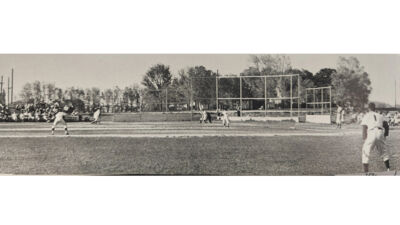
Throughout the entirety of the 1950s, the baseball team played its games on the patch of dirt on the northeast part of campus, on top of the hill. The field remained in this location for the better part of the 1960s. A panoramic photo of the field from the 1965 season is included in that year’s Concordia yearbook. The field faced towards the southwest and included a simple backstop with a wooden base. Beyond the third base dugout, fans sat on wooden bleachers, watching as third baseman Courtney Meyer came charging forward to field an expected bunt.
By 1967, the field was relocated to the east campus valley, next to the present day tennis courts and just down from the Philip and Timothy dorm halls. The site yielded a unique atmosphere in which fans could sit on the grass berms for a perfect view of the action. As part of a gathering on June 5, 2026, to discuss the current ballfield project, John K. Seevers described the setting. Said Seevers, “One of my fondest memories of playing at the old field – we weren’t that great – but we always had a lot of fans. We were right there next to the dorms, and everybody would throw open their windows and play music. Fans would sit on the berm. It was a great atmosphere.”
The regular turnover in the head coaching position played a role in the program’s inconsistent results over the years. The list of skippers who presided over the team over the latter half of the 20th century is a long one. It includes, in order, Luther Schwich, Rueben Stohs (who had five separate tenures!), Jack McBride, Gary Steinmiller, Carl Everts, Steve Sirek, Brian Mueller, Tim Warneke, Courtney Meyer, Dick Lemke and Gene Faszholz. The longest consecutive tenure of any of those coaches was six seasons. Some served as mere placeholders until a new coach could be found.
From an on-field perspective, Steinmiller managed to get the best results. He produced a 97-78 record over seven seasons leading the baseball team (1969, 1974-79). A 1976 graduate, Russ Daehling took pride in the fact that his teams reached the district playoffs in each season of his career. The ’74 team posted an overall mark of 18-10 and tied for second in the conference standings. In his final season as head coach, Steinmiller’s ’79 team finished at 15-9 overall.
At the beginning of the decade, the 1970 team established a school record for wins that would stand for more than 30 years. The ’70 squad went 19-9 overall and set additional program standards for runs scored (173), hits (214) and pitcher strikeouts (169). The yearbook mentioned several top players by name, including Jerry McFarlin, Ray Reisig, Mark Muller, John Reisig and Fred Clatanoff. It was the one and only year that Carl Everts (future AD) spent as head baseball coach.
Those who fixated on the results were not going to find fulfillment. Baseball at Concordia was about the love of the game. That point is understood when one peers at the year-by-year records attained throughout the 1980s and 1990s. As the record books state, the program almost didn’t make it to the 1990s. The following passage comes from the official “1988 Concordia Baseball Season Summary.”
It reads, “The 1988 Concordia baseball season began in September 1987 as a roomful of Bulldog hopefuls attended an organizational meeting and convinced the College Administration there was enough student interest to continue the baseball program. Although they had no coach, all their scholarships had been eliminated, and their operating budget was cut by more than 60 percent, four returning players and 13 newcomers decided to represent Concordia on the diamond in 1988.”
Tim Warneke stepped up to coach the team that season. He was tasked with raising money to fund a schedule. Fundraising endeavors included a sno-ball softball tournament, an Arkansas Gems women’s professional basketball game staged inside the PE Center Gym and phone-a-thons. Warneke was so resolved to keep the program alive that he organized the aforementioned initiatives and even sold doughnuts on Saturday mornings and participated in a scientific study that netted $400. Warneke described the Arkansas Gems as the Harlem Globetrotters of women’s basketball. Said Warneke, “We had to fill the old gym. It was a great night. We raised enough money to take a spring trip to California.”
And so baseball endured at Concordia. The ’88 team went 10-27 overall in following up a 2-26 campaign in 1987. The program would not win more than 10 games in a season again until 2000. As Warneke detailed, the resources and the budget were tight. (Notably, the 1986 team shared the NIAC championship with an 8-4 league mark. Current Head Athletic Trainer Randy Baack pitched and played first base on that squad). For many Bulldogs of the 1990s, baseball represented a secondary sport. That was the case for standouts such as Ross Wurdeman, a future Nebraska Football Hall of Famer. Wurdeman pounded nine home runs for the 1999 team that posted a 5-38 record.
By 1992, the program moved its home games off campus to Plum Creek Park, where the city of Seward had built a baseball field and two softball diamonds. Concordia traded its unique berm setting for an improved Plum Creek facility with lighting that allowed for night games to be played. The ’92 season coincided with Dick Lemke’s first of five years as head coach.
Unfortunately, wins became few and far between. According to the 1998 yearbook, the program dropped 111 consecutive games to NAIA opponents in a streak that began in 1995 and finally ended with a win over Northwestern on April 18, 1998. Several alums who played for those teams have recalled that the streak was mentioned on ESPN’s SportsCenter at the time.
Though the losses piled up, the coaches and players formed fond memories in their shared experiences. Said Aaron Krieser, “I won’t miss playing baseball as much as I’ll miss doing stuff with the team. I really liked hanging around with those guys.”
The former pro baseball player Gene Faszholz stewarded the program in 1997 and 1998, but he did not view his position as a long-term commitment. Concordia Baseball sorely needed stability and greater resources, components of a successful program that were missing throughout its history. Just three years after graduating from Concordia, Jeremy Geidel answered the call in 1999.
Geidel’s tenure brings stability
Jeremy Geidel played both baseball and football as a student-athlete at Concordia. In addition to taking on the head baseball position, Geidel quickly became the Assistant Athletic Director to Athletic Director Grant Schmidt (also the men’s basketball coach). Having played in the 90s, Geidel knew exactly the kind of uphill battle that faced the baseball program. Geidel helped bring it into the modern era and through the transition from the Nebraska-Iowa Athletic Conference to the Great Plains Athletic Conference, a league that celebrated its inaugural season of competition during the 2000-01 academic year.
Considering the program won a grand total of 28 games during the 1990s, the 2000 season (the last for the NIAC) marked a major breakthrough. In his second season, Geidel led the Bulldogs to a conference record of 11-11, good for third place out of seven teams in the NIAC. The turnaround resulted in Geidel being named the 2000 NIAC Coach of the Year. NIAC All-Conference honors were earned by catcher Jarrod Pimentel, first baseman Nic Kulinski and pitcher Nick Eckmann. They helped lay the groundwork for a run of solid seasons.
Geidel’s tenure spanned 16 seasons (1999-2014) and was highlighted by 20-win campaigns in 2004, 2005 and 2012, a figure the program had never reached during the 20th century. The ’05 team, featuring First Team All-GPAC honoree Kevin Hanley, produced a 15-9 conference mark and placed fifth in the GPAC standings. In 2012, the Bulldogs reset the single season wins standard (25) behind outfielder Zak Goodrich, one of the top players in program history. Goodrich earned back-to-back first team all-conference awards and pounded out 234 hits in his career (a school record at the time).
In addition to Goodrich, Hanley and Pimentel, Geidel coached additional first team all-league selections in Joey Steinbach and Zach Williams. The top offensive players, in terms of hits, during that time period were Goodrich (234), Jerry Dittenber (192), Nate Schmoll (189), Tim Ahlman (182), Casey Rodriguez (164), Matt Duchek (160) and Jeff Davis (151). On the mound, Seth Pawling and Steven Ivanoff won 20 and 15 games, respectively, in their careers.
Geidel hit 250 career wins in his 16th and final season. Geidel announced his resignation following the 2014 campaign, which concluded with a 16-30 record (6-14 GPAC). While the program had fallen short of winning a championship, Geidel brought organization, greater talent and increased visibility to Concordia baseball. Geidel stated at the time, “I’ve been blessed to have the opportunity to work with and build relationships with so many outstanding young men over the years. I appreciate Concordia University supporting me and providing the chance to come back to my alma mater.”
Dupic and the program’s golden age
Director of Athletics Devin Smith identified Ryan Dupic as a “rising star” in the coaching profession in the summer of 2014 when an announcement went public. A native of Emmetsburg, Iowa, Dupic had spent the previous seven seasons overseeing the pitching staff at NCAA Division III Buena Vista University (Iowa), his alma mater. When Dupic was hired prior to the 2015 season, Concordia Baseball had not turned in a winning overall record since 1979.
No one likely could have predicted the success that was about to come. The ’15 team broke the school record for wins in a season (26) but missed the conference tournament. The school record meant little at the time to Dupic, who had a vision for building a championship program. By year three of his tenure, Concordia celebrated a GPAC regular season title thanks to a 19-9 conference record. For the first time ever, the Bulldogs were headed to the NAIA national tournament. Such accomplishments in 2017 occurred as Dupic battled cancer. It was emotional for everyone involved. Dupic broke down when he first informed the team that he had been diagnosed with a form of cancer called squamous cell carcinoma.
As Dupic said, “It was the first time that I cried about it. It hadn’t really hit me until I stood in front of them and realized that I wouldn’t be able to be with them every day. I like to be with my players every day.”
Dupic overcame cancer and did not miss a season. He felt stronger heading into the 2018 campaign. He was disappointed in the end result – a 25-22 record (13-13 GPAC) and an early postseason exit. It proved to be a blip on the radar.
In the first 12 years of his tenure, Dupic has become the winningest head coach (403 wins) in program history while leading the Bulldogs to a combined eight national tournament appearances, five GPAC regular season titles and three GPAC tournament championships. In May 2021, Concordia realized a dream in qualifying for the NAIA World Series. The achievement of such a feat would have felt virtually impossible back in the 1990s.
Naturally, Dupic’s teams have completely rewritten the program’s record books behind a powerful lineage of home run hitters. Sluggers Joey Grabanski and Jaidan Quinn both earned GPAC Player of the Year awards as part of sterling careers. During the 2021 through 2025 seasons, the Bulldogs hit at least 90 home runs each year. Dupic has coached seven players who have earned All-America awards: Nick Little (2018), Jake Fosgett (2021), Jay Adams (2022), Grabanski (2023, 2024), Quinn (2023, 2024, 2025), Matt Rhoades (2025) and Bronx Lewis (2026). That list doesn’t include Jason Munsch, a 2020 Milwaukee Brewers signee, or Alex Johnson, a two-time GPAC Pitcher of the Year.
The magical run of 2021 included a GPAC tournament championship and an NAIA Opening Round title secured as part of the Bellevue Bracket. In the national tournament, Concordia won three-straight elimination games, including two over the host Bellevue Bruins. In the clinching game, the Bulldogs erased a 5-3 deficit in the bottom of the eighth as Keaton Candor popped a solo homer, Jacob Faulk launched a go-ahead two-run shot and Teyt Johnson went deep for an insurance run. Nathan Buckallew then pitched a 1-2-3 ninth to set off a dogpile on the infield at Brown Park in Omaha.
A year earlier, Dupic and his team dealt with the shutdown of the 2020 season as the COVID-19 pandemic gripped the world. At the time, Concordia sat at 14-7 overall and was the favorite to win the GPAC. Jason Munsch and Nick Little both threw no-hitters. In four starts prior to the shutdown, Munsch fanned 59 hitters and did not allow a single earned run in 26 innings (.103 opponent batting average). The run of dominance earned Munsch an undrafted free agent contract with the Brewers organization.
There will be plenty of Concordia Athletics Hall of Famers that emerge from the Dupic era. His tenure has produced program all-time offensive record holders in Jay Adams in runs (286), hits (352) and doubles (69), Jaidan Quinn in home runs (98), Joey Grabanski in batting average (.382) and RBIs (300) and Zackery Day in stolen bases (107).
The Bulldogs will carry a string of seven consecutive national tournament appearances into 2027. During the streak, Concordia has placed either first or second in the GPAC each year. In each of the past six years, the Bulldogs have won at least 38 games, putting themselves in the same breath as the powerhouses of NAIA baseball.
The winning culture Dupic built is centered upon close relationships and strong Christian faith. When discussing the senior class following the 2025 season, Dupic stated the following, “They just really exemplify who we are as people and the culture of the program. They’re so bought into this thing. That’s the part that’s really special – when you look back and you have really good relationships. The guys invest so deeply into each other. The culture is something really special. Their accomplishments will be remembered for a long, long time. They’re in the record books and all that stuff, but it’s a special group to be around. They love to be around each other. It makes for a tremendous experience for everyone involved.”
The future
The future will connect Concordia Baseball to its past as home games return to the same plot of land where Bob Gibson once toed the pitching rubber. The success achieved by the program over the past decade has been especially impressive given that Coach Ryan Dupic’s teams have had limited access to a baseball field. The constraints of sharing Plum Creek Park have intensified in recent years, but the Bulldogs keep on winning.
Once the ballfield project is completed, Concordia will immediately boast one of the finest baseball facilities in the state, the region and the NAIA. Dupic looks forward to more consistency in practice and in scheduling home games. The synthetic turf will lessen the impact of inclement spring weather and allow for the team to get on a diamond earlier in the calendar. It will also lead to fewer missed classes and a better overall experience for student-athletes.
The new diamond will become a source of pride for Bulldogs past and present. Considering all circumstances, the baseball program has never been better positioned to thrive. From humble beginnings, moments of turbulence and exhilaration, the baseball program is prepared for the next chapter within a state-of-the-art facility.